
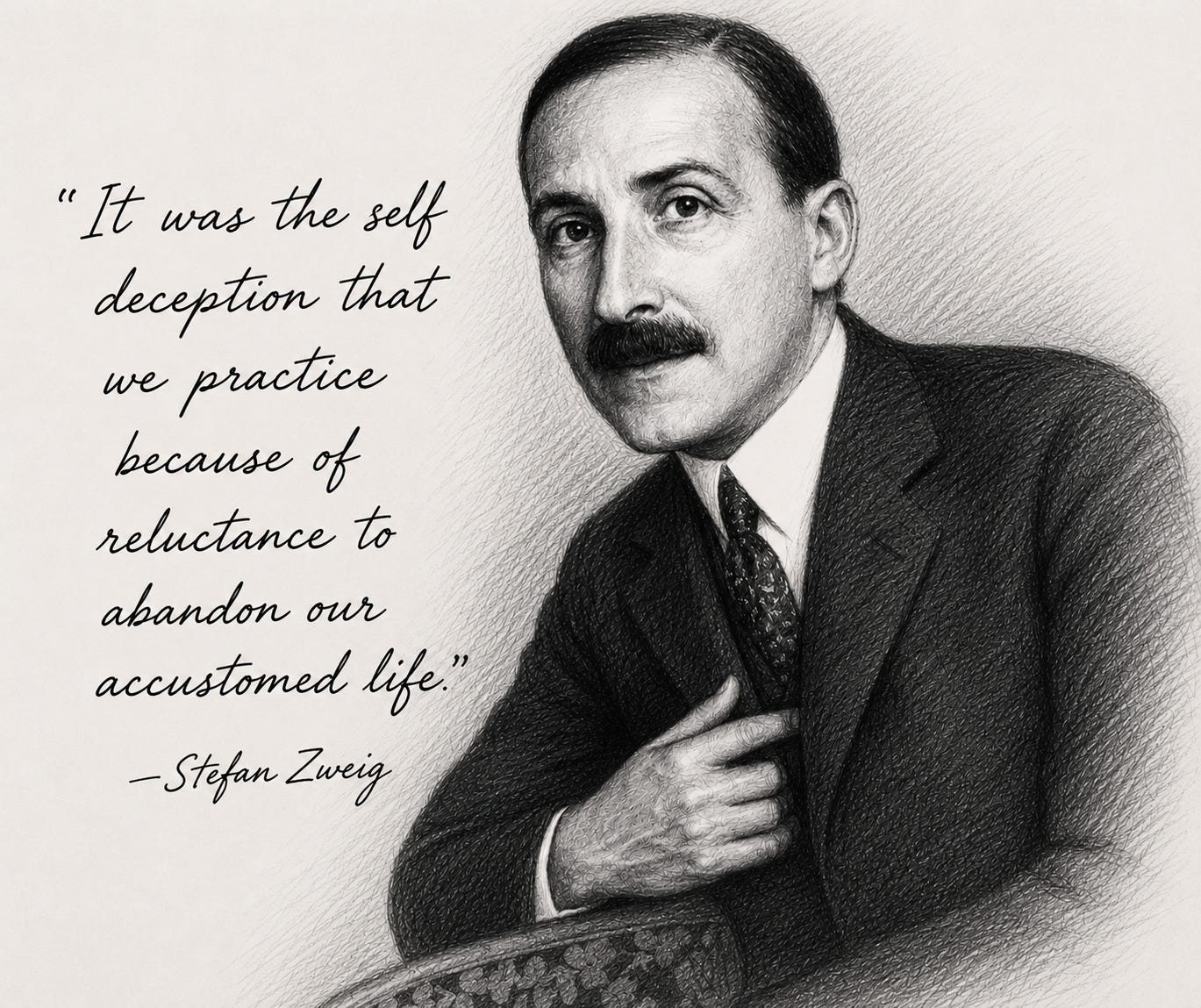
On his fiftieth birthday in 1931, Stefan Zweig, the unrivaled European humanist and chronicler of his age, had this to say,
“It remains an irrefragable law of history that contemporaries are denied a recognition of the early beginnings of the great movements which determine their times. So I am frankly unable to recall when I first heard the name of Adolf Hitler, that name which for years we have been forced to think of or to pronounce every day, yes, almost every second, in one connection or another; the name of the man who has brought more evil to our world than any other through the ages.”
Later in that same chapter Zweig wrote, “But even then (1931) I did not suspect when I looked at these fugitives ( the great writers, poets, musicians and intellectuals who were his friends and forced to leave Europe) that I ought to perceive in their pale faces, as in a mirror, my own life and that we all, we all, we all would become victims of the lust for power of this one man.”
The quotes are from Zweig’s memoir, The World of Yesterday. It was sent to his publisher the day before he took his life on February 22 1942, in a mountain town in Brazil. For Zweig the civilization that had produced Goethe, Beethoven, Erasmus, and Freud seemed irretrievably lost.
Now, ask yourself, “Is this where we are today in 2026, ‘contemporaries denied a recognition of the early beginnings of a movement which determines our times,’ though in a different era and with different men given to destroying everything we cherish.
Are we ignoring the unmistakable warning signs that our civilization is capable of descending into barbarism again because admitting that would require abandoning familiar assumptions and our accustomed life?
We really should see the writing on the wall by now “all, we all would become victims of the lust for power of this one man.”
Thank you this well written warning.