
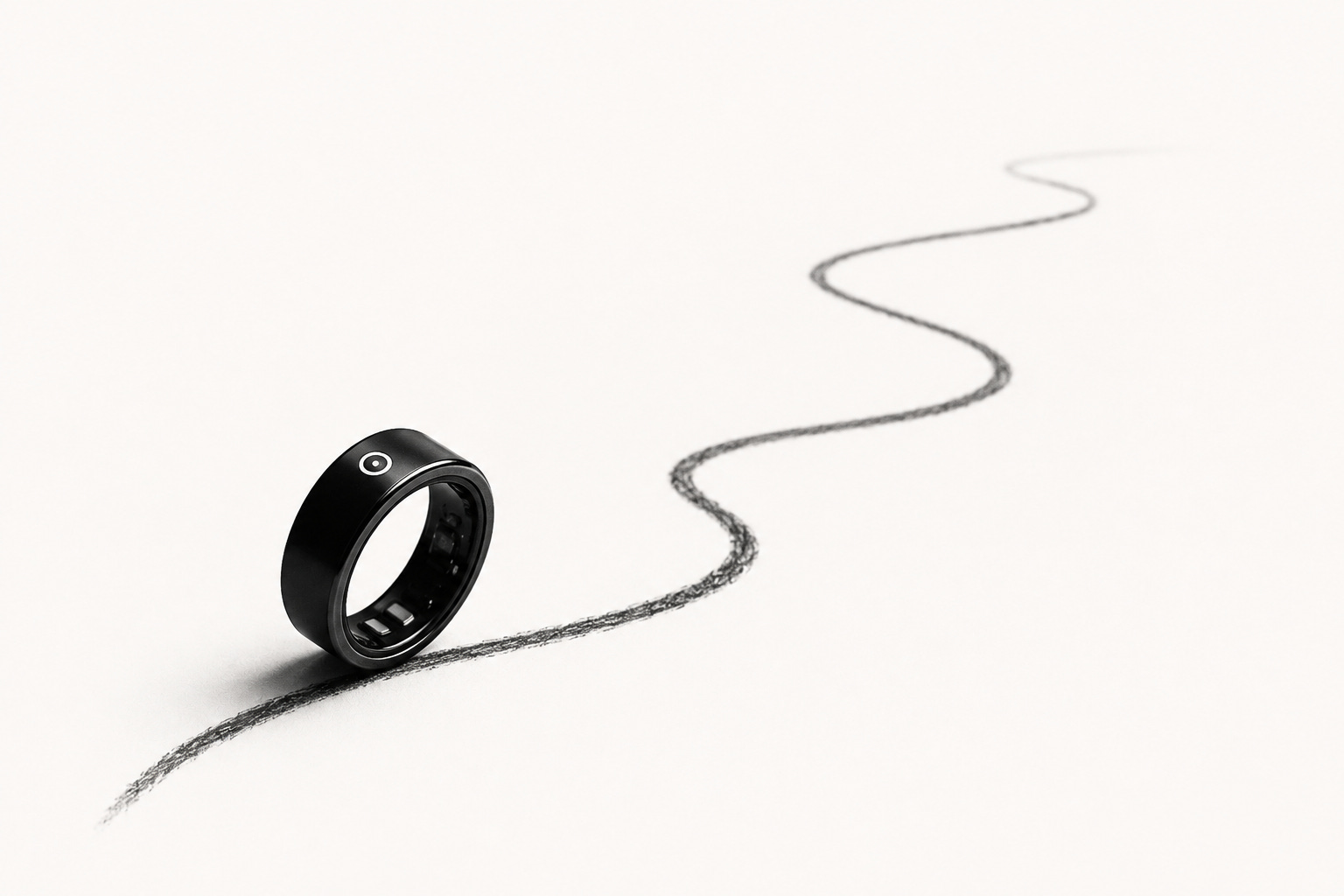
I’ve been wearing an Oura ring for a few years now and realize it’s changed much in my day to day experience- and the change isn’t good.
Like the proverbial frog in boiling water, I’ve slowly developed an objective framework through which much of my experience now passes. It’s objective because it’s about measurements rather than subjective or felt experience.
Since acquiring an Oura ring it’s not enough just to have a good or bad night’s sleep. I want to know Oura’s scoring of my sleep, exactly how much REM and Deep Sleep I’m getting and the precise number of hours and minutes I was asleep. I also want to know the time I was asleep compared to the time I was in bed to determine my sleep efficiency. In short, Oura’s score eclipses my own sense of how well I sleep.
The same thing happens when I walk along the narrow windings streets of the Berkeley hills. It’s no longer enough to breath in the fresh air, commingle with nature or sense my body moving through space. Instead, I find myself paying attention to the number of steps I’m taking, how fast I’m taking them, my heart rate and the number of calories I’m burning.
The Oura ring imposes an instrumental, accumulative frame on activities that were previously lived from the inside- sleep, walking, breathing- while degrading the experience in the act of measuring it.
To make matters worse I often compare Oura’s numbers with those on the activity app of my Apple watch And I find it upsetting when the numbers don’t match up. It’s as if the device with the lower number is cheating me.
Over the years I’ve eschewed social media knowing what an attention suck and waste of time it was. But here I am caught in the clutches of my Oura ring. Is that really much different than being captive to Facebook, TikTok or X. And though it’s not quite the same as hanging on to every word of the biohacker Bryan Johnson or The Look Smaxxer it’s in the same neighborhood.
What’s truly dispiriting about this is that the simple joy of being in nature doesn’t seem cut it any longer with the dopamine rush. It seems to prefer the readout on my Oura ring, chasing the low hanging fruit, quantified experience.
I’ve also noticed that I’m not only taking these measurements for myself but to impress my friends. It sounds more arresting as an octogenarian to say I took 10,000 steps than I had a pleasant walk in the hills.
The humorist Gary Shteyngart has recently written a novel about this strange way of being. The book is called Super Sad True Love Story and it’s about a poor schlep who lives in a world in which all experience is subject to quantification. Shteyngart’s near-future America runs on what’s called the äppärät, a pendant device everyone wears that streams data continuously and ranks people in real time. There are, for example, credit poles on the street that broadcast your financial worth as you pass by. In Shteyngart’s world the body is quantified with biomarkers and mortality odds that track your data like stock portfolios. And there are companies that provide dechronification, the undoing of time, and indefinite life extension for high net worth individuals.
This quantitification of experience aligns with what some are calling techno-fascism. If our every data point is available to the state, thanks to companies like Palantir, how will it not be used by bad actors, like the present gang in Washington DC, to control our private lives.
Data collection has always been the infrastructure upon which authoritarianism rides. It doesn’t cause subjugation but subjugation at scale is impossible without it. Quantifying much of our experience hands the state a map of each individual where otherwise there’s only a blank.
We’re not there yet, but it’s coming our way. How soon will it be before the government is able to capture our own quantification of experience. And with strong AI that capture will vastly expand. Of course, we’ll be offered plenty of goodies along the way to get on board, fascinating new data points, so it won’t necessarily be apparent to most of us what we’re giving up.
Though classical fascism coerced through terror, spectacle, and visible violence, techno-fascism operates closer to what the French philosopher Michel Foucault described as the move from discipline to internalized self-surveillance. It’s also what another French philosopher Gilles Deleuze called the control society- the authorities no longer need informants and watchers once the citizenry has adopted quantification as the lens through which they understand themselves.
And a third Frenchman, the philosopher and historian Jacques Ellul, has pointed to another subtle and insidious threat: the rise of “Technique.” It isn’t just about machines or gadgets (think wearables) but about the ‘principle of efficiency’ becoming the dominant force in all human endeavors. With each new technological advance there’s increased opportunities for efficiency. And there’s no doubt that my Oura ring is far more efficient than I am.
The quantification of experience is corrosive precisely because it feels frictionless and fun. There doesn’t have to be a Gestapo or Stasi to keep us in line. We’re performing that job ourselves when we undermine our felt sense of being with “Oura says my readiness is 92.” This is vastly more efficient than terror because it is voluntary and engaging. But it produces docile, self-optimizing subjects who experience their own subjugation as self-improvement. In that world there’s no need for a boot.
Finally, this brings to mind something analogous. It’s said that what George Orwell feared were those who would ban books but what Aldous Huxley feared was there would be no reason to ban a book because there would no one who wanted to read one.
Thanks for your comment. The Buddhists promote moderation in all things and the Oura ring is no different. When it's useful use it, when it causes distress don't. It's just a bit of technology but doesn't have a mind of its own, but you do.
Good to hear from you, Rick. As you might imagine I exaggerated a bit to make the point. We spend much time walking in Tilden without monitoring our progress but we do monitor our sleep since Deep sleep is very important as we age. I think we may be the last generation that hasn't been captured by the quantification of experience.