
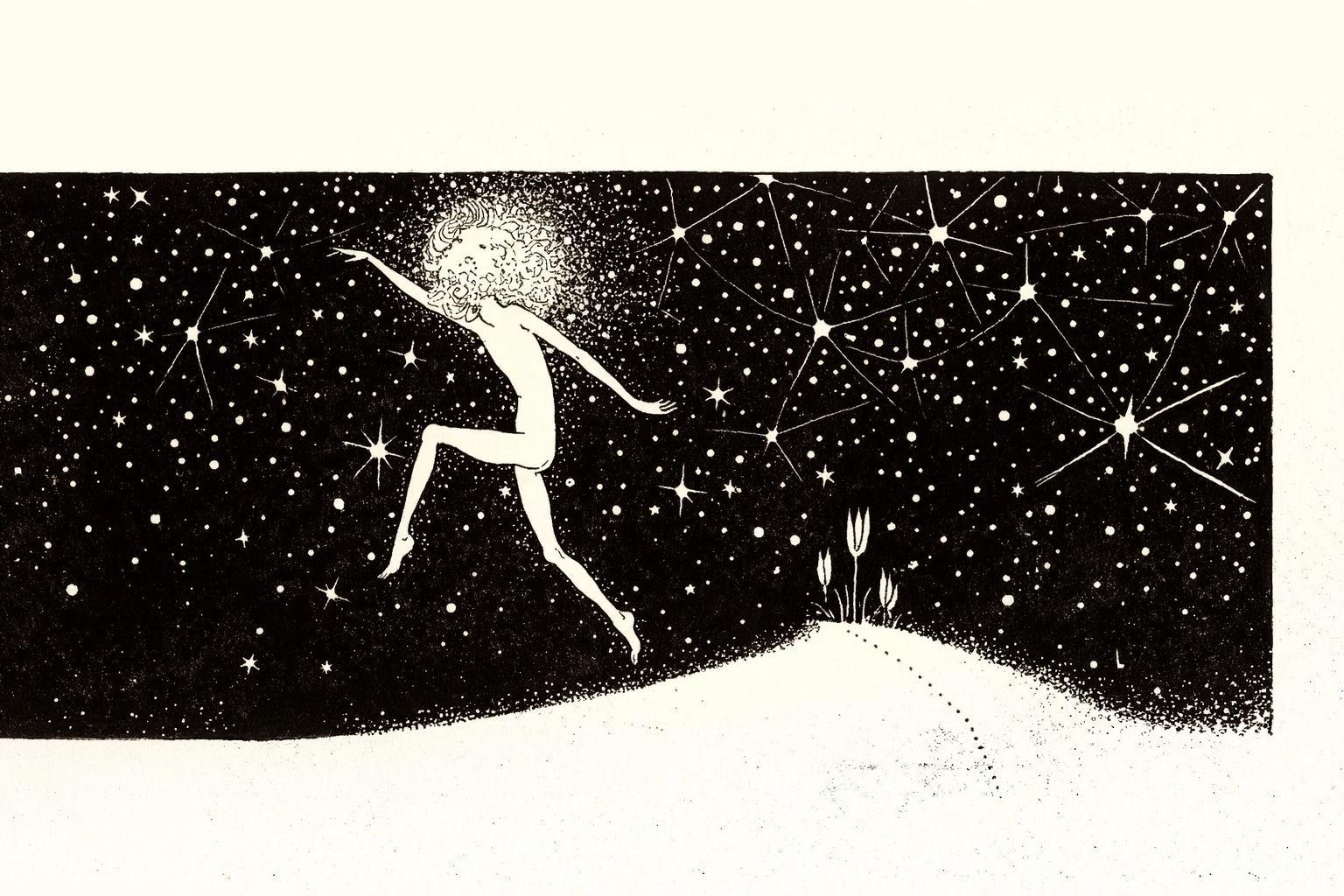
It was a dark night on the Big Island of Hawaii. I stepped away from lights around the condo to see a sky populated by stars. I could feel tension in my eyes as I strained to see what the naked eye doesn’t allow. So I fetched a pair of binoculars to see distant stars by the the hundreds, maybe thousands. But what to make of it all?
I was in the middle of nowhere, so to speak, some 2300 mls from the closest continent. It’s an ideal spot to contemplate life’s mysteries as well as take a break from thinking about our world gravitating toward authoritarianism and on the cusp of whatever AI’s alien intelligence serves up. And culture wars or mean spirited politics have little purchase here in the face of nature’s endless mysteries and terrifying beauty.
An island is particularly well suited to contemplate the ‘big questions’ of our cosmic circumstances. I think of it as locating our metaphysical and spiritual coordinates- where are we exactly and how do we know where. Bumping up against those questions is another- what is this thing called gravity that binds us to the earth and the earth to its star.
These are questions for an undistracted mind to contemplate. When thoughts quiet down and the mind can acutely focus one can zoom out from conditioned existence and catch a gimpse of actual circumstances.
If I were more the poet I’d give expression to my own contemplations but I am not. Instead, I look to what our most imaginative and insightful philosophers, writers and scientists have had to say about our cosmic circumstances and making sense of it all.
There’s such an enormous body of writing on the great metaphysical questions that I often use an AI to help me access a narrower range of writing on topics like first causes. The AI is a virtual curator of sorts.
As I hover over the prompt the most fundamental question that occurs to me about first causes is this : why does anything exist at all rather than nothing. I type it into the prompt.
I’m not looking for answers, just reflections on an age old question. It’s barely conceivable, of course, that we humans possess the capacity to frame meaningful questions about first causes. Besides, the very concept of first causes- in the sense of A causing B- isn’t even a serious question in systems of knowledge where the universe is understood as “beginningless.”
In Western knowledge, however, cosmic cause and effect is generally taken for granted, or was until quantum mechanics upended Newtonian physics. There’s no shortage of philosophers now who insist that the very idea of cause and effect is a construction of mind rather than a reality. Nonetheless, I proceed with my question.
Though seemingly an ancient conundrum- why does anything exist at all rather than nothing- the AI attributes the question to Leibniz, the 18C philosopher and mathematician. Leibniz is said to have thought “it was the deepest question anyone could ask because reality didn’t just happen for no reason at all.”
Leibniz argued that the answer to why anything existed at all could not be found inside the universe because any part of the universe would itself need a reason. It was indeed an infinite regression in that one reason would then lead to another.
Leibniz’s solution was that “there must be a necessary reality whose reason for existing is contained within itself and that meant a being that cannot fail to exist, whose nonexistence is impossible.” In other words, a creator god for which there was no prior cause.
Leibniz’s reasoning didn’t seem to contain much reasoning at all about why the universe leapt into being. It took several hundred years for the likes of a Richard Feynman to casually remark, “I would rather have questions that can’t be answered than answers that can’t be questioned.”
With that in mind I put another question to the prompt. I wanted to know what a few named philosophers had to say about first causes. Reading the chat I soon realized that beneath my question was yet something even more fundamental and that’s the subject of this post.
Martin Heidegger, the German philosopher, wanted us to notice that things existing at all was extraordinary but that we usually fail to notice it or forget how much so. Heidegger argued that we’re so immersed in questions about first causes that we don't pay attention to the ground upon which it plays out, which is existence itself, the is of a world that we ask questions about. In his view, we fail to notice of just ignore that things just are.
Heidegger wasn’t concerned with first causes, physics, or origins but the sheer fact that anything shows up at all and the openness in which things appear. He wanted us to allow things to appear without forcing them into metaphysical, conceptual or emotional explanations or responses.
This threw me off because my intention was to explore first causes. Why there is anything at all wasn’t a puzzle to be solved, according to Marin Heidegger, but a lived experience and a wonder in itself. Being for him wasn’t about us or our explanations but what he termed the clearing, the background absence that lets presence stand out. Heidegger called it Das Nichts, the nothing, the open field in which, astonishingly, anything appears at all.
In this scheme humans do not matter in the sense that they exert control over the world but because they are the beings who notice that there is a world. And they do so because they possess awareness of being-there.
Heidegger used the term Dasein, literally being-there, to describe our circumstance as beings in the world who wonder about things relating to our own existence. We are the place where being becomes visible and expresses itself thru language. “Language is the house of being,” he wrote. It’s where humans dwell.
I felt that Heidegger had taken me beyond where I had intended to go and my head was spinning. I wanted to return to where I had begun, with what philosophers, writers and scientists had to say about first causes but I was already too far down another road.
Now I was more interested in what writers and poets aligned with Heidegger’s views had to say. Heidegger himself had written an essay entitled “What Are Poets For?” In that essay he focused on two poets in particular: Rainer Maria Rilke and Friedrich Hőlderlin. The latter’s poetry, Heidegger wrote, expressed presence before explanation. What, I wondered, did he mean by that.
Heidegger wrote that great art, especially poetry, wasn’t meant to represent things but to reveal a mode of being. It brought a world into presence without explanation thus inviting the viewer into a different relationship with existence. He argued that art doesn’t just adorn reality but reveals it. Art opens things up, allowing one to see the world thru a lens even more elusive than what I surmise Buddhist and Taoist masters have considered non-conceptual.
In Rilke and Hőlderlin, Heidegger found kindred spirits though he had his differences with Rilke. Rilke had recognized the experiential nature of being but that wasn’t enough for Heidegger. Heidegger criticized Rilke for treating being as something that must be lived inwardly- feelings, perhaps- rather than letting it appear as a ‘non-subjective disclosure’ by which he apparently meant the way in which things just show up as something.
Though confusing, I wasn’t entirely unfamiliar with these complex and nuanced ideas. During the past several years I’ve been introduced to Buddhist teachings on non- duality and pre-conscious awareness. In the Yogacara tradition there are teachings on non-dual awareness that precedes consciousness.
My understanding of the Yogacara intuition is that when consciousness arises it brings with it a lot of baggage-a sense of self and time; habits of mind, past experiences, biases, emotions, projections etc, etc. Because the mind is essentially a difference making machine it divides arising phenomena into subject and object- examples include me and the world; us and them; good and evil; right and wrong; success and failure; this and that; up and down, etc, etc.
In deep meditation skilled practitioners are said to be able to focus their attention so acutely that the dualistic framework drops away and they’re left with a blank-canvas like mind able to perceive the flow of phenomena free of concepts, boundaries and categories.
Heidegger was pointing to something in that direction but taking it even further. He rejected any metaphysic that made claims about what ultimately exists and upon which everything else depends. That would have included any explanations that address questions like mine- ‘why does anything exist at all rather than nothing.’
I suspect Heidegger would have considered Yogacara to also be a metaphysic, a mind-based view, because it proposes that ‘subject and object’ arise within consciousness. It’s a foundational idea and that would seem to make it a metaphysic of mind.
Neither the poets nor Yogacara went far enough for Heidegger. He argued that before we can think about objects, describe them, or experience them, they must already be there and be encountered. Pre-conscious awareness wasn’t what he had in mind as being. He was interested in what preceded it, just the encounter with what is itself.
As far as we know Heidegger didn’t engage in meditation nor psychedelics so I wondered where his intuitions came from. But that’s a whole other story so I’ll end this post here and may return with how Heidegger’s intuitions were likely inspired by Greek philosophy.
Thanks for your comment.
Thanks so much for this post!
This is the big question. The more I read about it, the less I know. And the less I know, the more I read. It leads to so many other questions!
I have a copy of Being and Time, but have yet to attempt it. It is too much for me at this point in my journey. Thank you for explaining some of Heidegger's thinking so clearly.
I sometime take comfort in a quote that I thought was attributable to Kurt Vonnegut, but I could be wrong. "If we knew the answer, there wouldn't be any more questions." And yet, the quest continues... So it goes.
Thank you!