
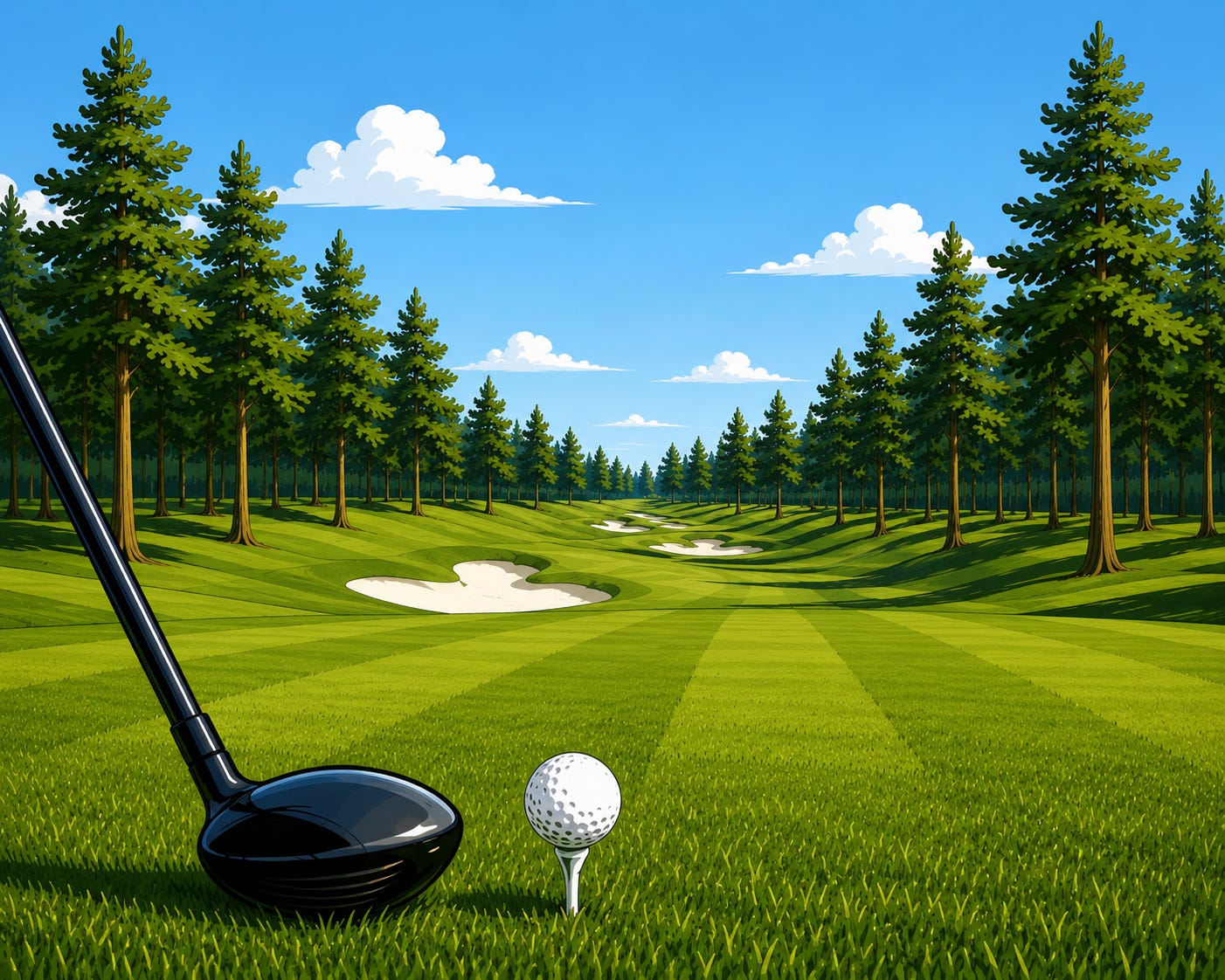
The game of golf requires a set of clubs, a bag of balls, a glove and the official rules. It’s somewhat of an ancient sport so the rules have a long history and are thought to be inviolable. But what those rules mandate is not the only way to play golf. Clubs, balls and glove can be deployed on the course in ways that don’t conform to the rules.
Take my game, for example. I don’t play golf as prescribed by the rules. I neither keep score nor have a handicap and I tee up on fairways and pick balls out of sand traps. Yet at my age (83) there are few physical activities I find more rewarding than playing golf. Each hole provides an opportunity to experience a sense of presence undistracted by thought, though it’s not an opportunity often taken.
I began teeing up on the fairways after being diagnosed with cervical stenosis. My orthopedic surgeon, a golfer himself, warned me that hitting the club ‘fat,’ into the ground- reverberates into the neck and would eventually lead to severe pain and eventual laminoplasty- breaking open the vertebrae to allow the compressed nerves more space. He added that it was a painful recovery. “You better tee up on the fairways,” he cautioned.
I had already been playing golf without keeping score so teeing up on the fairways was just another modification to the rules of the game. And since I was ignoring the rules anyway I eventually started picking balls out of those pesky sand traps.
As I abandoned the rules of golf what came to matter most to me was seeking that feeling of alignment between my body and whatever forces of nature come together in the golf swing. When able to experience it, though not often enough, I’m much more likely to make a clean strike at the ball.
It’s the same thing with putting- a sense of presence and a quiet mind allows for a rhythmic stroke. Then there’s the excitement of watching the ball make its way to the hole, very speedy at first then slowing to a stop, holding me in suspense all the while.
I consider being aware of my body in space and my mind free of swing thoughts to be the greatest challenges in golf. I really don’t need other challenges on the course, like hitting the ball from a bad lie or out of a bunker.
From time to time, of course I consider the downside of not playing the game like everyone else. I miss out on the satisfaction of making that occasional good strike from a bad lie or deep bunker. I’m also not able to participate with other players in club tournaments or track a handicap up and down. And when I share a tee time with strangers I have to explain myself, though I usually just say ‘I’m monkeying around’ and leave it at that.
I’m not unmindful of the trope that golf is a metaphor for life. The game replicates the structure of human experience with its obstacles, recovery, fleeting moments of exhilaration and long stretches between holes when one considers how to play the next shot. It mirrors life in its challenges, uplifting moments, regrets, self-reflection and criticism.
Though the metaphor holds up well I’m willing to forego all the life lessons golf teaches in favor of the challenges I aspire to and that matter most to me. When I make my way to that first tee box I have a very different intention in mind than other players.
It wasn’t always this way. There was a time when I played golf according to the rules. But because I’m somewhat of a perfectionist having to pencil in a double and triple bogey on my card was excruciating. And how many times were my hopes for a decent scorecard dashed on the first hole by a triple bogey. Yet I had to go on. My body would stiffen and my arms would tighten, making it ever more difficult to properly swing the club.
I also suffered the unhelpful habit of interrogating myself after poor shots- how could I have possibly lost my swing plane; failed to turn my shoulders; held the club head way above where it should have been; or raised my head prematurely. I would churn these questions over in my mind and, of course, they compounded into additional poor shots. Often upon completing 18 holes of golf I was relieved to be done with it. I would swear off playing ever again but, of course, be back the following weekend for more.
To continue playing golf and actually enjoy it I eventually decided that keeping score had to go. I would simply leave the score card unopened on the cart. Then I began to ponder how else could I improve my chances of enjoying a round of golf.
Teeing up on fairways was not only a way to increase the likelihood of a good strike but then became a necessity given my medical diagnosis. With only a tinge of guilt I completely gave up playing golf accordingly any rules.
It was about that time that I drifted into an entirely different way to think about the game. And that brings me back to what I wrote earlier about aligning body and mind with ‘natural forces, for lack of a better way to put it.
You may think what I’m about to write is woo woo but I assure you it is not. By alignment I’m referring to the sense that you’re tapping into something beyond yourself, the rhythms and patterns of energy in which we’re all embedded. Alignment is what thins the veil between us and the field or structure we’re moving through. It’s the freedom we can experience when we’re not distracted by thoughts and rumination. What drops away is the consciousness of oneself (literally ‘self-consciousness’) in time and space, and the sense of a me doing something. It’s a meditation on the golf course.
That understanding as applied to golf was fictionalized in the cult classic, Golf in the Kingdom. Its author, Michael Murphy, a co- founder of the Esalan Institute for transpersonal psychology, undertook to explore the metaphysical and mystical possibilities in the game.
In the book Murphy, the protagonist, stops in Scotland on his way to India to study with a renowned sage. He intends to play a round of golf at a fictional course, Burningbush, and is paired up with the club’s elusive and mysterious pro Shivas Irons.
Murphy learns many things in his round with Shivas Irons but the most important thing he learns is that the ideal swing isn’t a mechanical nor muscular effort but a surrender to ‘deeper forces,’ sensing the ‘land’s energy’ as a palpable force which Shivas Irons terms “true gravity-“ a universal principle connecting the player to the earth’s rhythms. Transcendent shots that seemed to defy physics are attributed by Shivas Irons not to technique but to aligning one’s swing with this energy.
I was already familiar with many of these ideas- they’re at the core of the wisdom and spiritual traditions of the East. Now I wanted to explore them on the golf course and see if I could relax my rational mind and let feeling rather than thought guide my play. I knew it would be very difficult to do and I would move in and out of alignment.
It’s been particularly helpful to bring to mind the notion in Taoism of wei wu wei, effortless action, a doing-not-doing. If you’ve watched the extraordinary movements in a Bruce Lee or Jackie Chan film you’ve watched wei wu wei. It’s allowing a deeper current to move through you- the path of least resistance. With respect to golf it’s trusting your feeling rather than your mind with its abundance of swing thoughts.
This isn’t a philosophy of passivity. It’s a description of how synchronicity and coherence work once you accept the intuition underlying each. When you’re in coherence -present, open, trusting what you feel- you pick up those signals.You hold the visualization of the golf shot but surrender the how because the how is being handled by something with a much wider view than yours. You are not surrendering to something outside yourself but to yourself.
Yet the ego jams the signal because it doesn’t know the signal exists. The ego is just doing its job, it’s planning, predicting and controlling. It’s navigating by force rather than feeling. The difference between the two has been described as the difference between hacking through a jungle with a machete and being carried by a river that already knows where it’s going.
Every ounce of energy poured into controlling the golf shot is an ounce of attention pulled away from receiving the signal, blocking the feeling that leads to your full potential. It’s what athletes mean when they talk about being in the zone. It’s peak performance as a form of attunement toward something greater than your self.
The golfer who plays for that feeling, the inner experience, rather than a number on a card is, as Murphy writes, closer to the spirit of the game Shivas Irons plays.
To focus too much on the score or the competition, he cautions, can become a self-referential trap, a source of anxiety that pulls a golfer out of presence and into judgment.
Murphy might not have been unsympathetic to a golfer like me who doesn’t keep score and tees up on fairways but loves creating the best conditions he can for making a clean strike at the ball or attentively stroking a putt.
On the other hand, he probably would have thought that the satisfaction I find in golf is at the expense of the instruction it offers. Murphy might have said that teeing up on the fairway is avoiding the very confrontations the game is designed to produce. The rough, the lie, the bad bounce invite surrender to the way things are in life. To accept that without becoming reactive, self- critical or frustrated is mastering oneself.
But I haven’t mastered myself. I tend to be emotionally reactive and self-critical, especially when taking up unwanted challenges that don’t end well, particularly on the golf course. I suppose I could use golf as an opportunity to work through these mental hindrances but I prefer to just enjoy the game the way I play it rather than work on myself by confronting golf’s many challenges.
Without having to think about a score or getting out of a difficult lie what remains is to be present for the feeling in my swing. And if everything comes together I can hit my 3 wood 150 yards or so. It doesn’t happen everytime I swing the club but often enough.
Of course, my way of playing golf isn’t for the vast majority who follow the rules, post a score and address every difficult lie. But I hope these words resonate with those who feel trapped by the rules golf imposes and no longer take pleasure in the game. And whether you play one way or the other all that really mattters is enjoying whatever the experience of golf has to offer you.
This strategy allows Howard to circumvent that old aphorism, "Golf is a good walk spoiled."
Onward & upwards...
So good, as always!